Avoiding a bust is not the same as avoiding a loss
Standing on every hard 12–16 guarantees that those hands will not bust through another hit. It does not guarantee a favourable settlement. Against a dealer ten, a standing sixteen still loses whenever the dealer finishes above sixteen without busting. The useful question is therefore the expected cost of each legal action, not simply whether a particular action can take the hand over twenty-one. Choosing an outcome that looks safer can cost more on average.
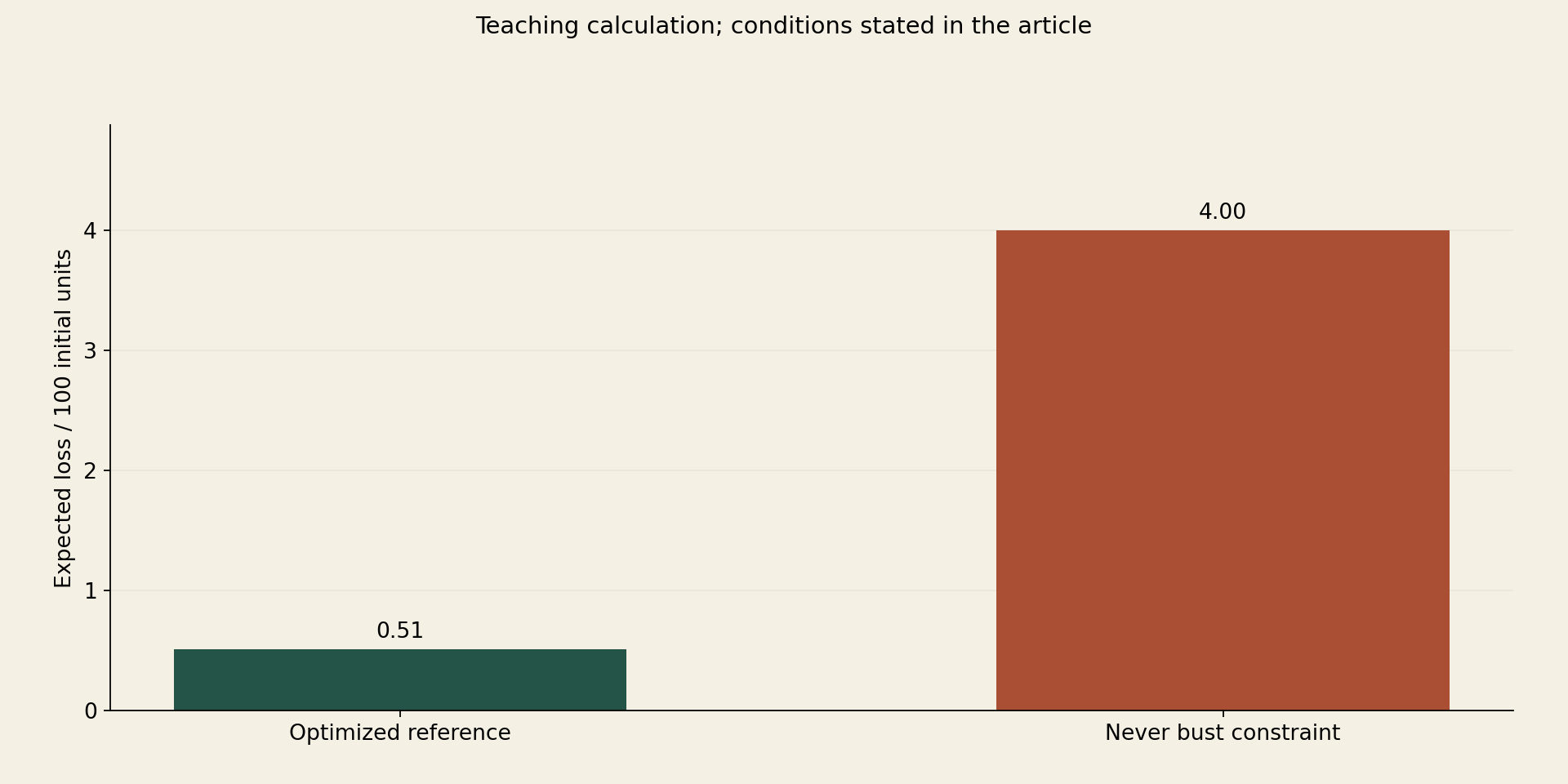
We calculated this comparison in an explicit infinite-deck teaching model. The optimized reference policy loses about 0.51 units per 100 initial units staked; a policy that forbids risky hits on hard totals of twelve or more loses about 4.00. The extra expected cost is about 3.49 units on that denominator. These are calculated expectations under the rules below, not results observed at a casino and not universal percentages for every blackjack table.
Fix the rules before quoting a percentage
Cards are independent draws with replacement: ace through nine each have probability 1/13, and a ten-valued card has probability 4/13. This is an infinite-deck approximation, not a six-deck shoe. The dealer stands on soft seventeen and checks for blackjack. A natural pays 3:2. Doubling on an initial two-card hand and after a split is allowed. Splitting can create at most four hands; split aces receive one card and cannot be split again. Insurance and surrender are excluded.
Those conditions determine which decisions are legal and how much each outcome pays. A table using H17, 6:5, no-hole-card rules or surrender needs a different calculation. Neither the reference chart nor the result below should be transplanted into such a game without adjustment. In particular, an expected value after the dealer has checked for blackjack is conditional on that check. Mixing it with a value before the check creates a false comparison even if both numbers were originally calculated correctly.
Define both policies precisely
The reference policy maximizes expected value over legal hit, stand, double and split choices in this model. The constrained policy uses the same optimization, but cannot hit or double on a hard total of twelve or more. Soft hands, doubles that cannot bust immediately and permitted splits remain available. This is a well-defined constrained strategy, not a claim that every person described as a “never bust” player follows the same chart.
We did not simply copy the doubles and splits from an unrelated basic-strategy table. Decisions are recomputed under each policy, including the consequences of later restrictions. Nor is this the separate casino game called No Bust or a variant that changes how totals over twenty-one are settled. The article concerns a restriction imposed on decisions in ordinary blackjack under stated rules. A special game's name cannot supply the probabilities or payouts for this comparison.
| Policy | Expected loss / 100 initial units |
|---|---|
| Optimized reference | 0.511734 |
| Never bust constraint | 4.001954 |
Read the denominator as initial stakes
The figures are net expected losses per 100 units of initial bets. Doubles and splits can add stakes after the original deal, so this denominator differs from all money wagered across every action. If every original bet were ten units, the calculated cost over 100 completed original deals would be about 5.12 units for the reference and 40.02 for the constrained policy. The difference is about 34.90. This is linear scaling of an expectation, not a predicted session balance.
A sequence of wins or losses can overwhelm these averages in a short sample. We have not derived a bankruptcy probability or a confidence interval from the two mean values. Expected value alone does not determine the spread of outcomes. A finite balance might also fail to fund a planned sequence of doubles or splits. That would create a different policy from the one evaluated, so the same expected-cost figure would no longer apply automatically.
The cost depends on the dealer's upcard
In the model, a hard twelve against a dealer two has stand EV near −0.29278 and hit-then-optimal EV near −0.25339. Hitting saves about 0.03939 of the original stake in expectation, despite the possibility of busting. Against a dealer six, standing on twelve is preferable to hitting. The “never hit a stiff hand” rule therefore makes some decisions correctly and others incorrectly. A blanket slogan hides the part that costs money.
| Hard total | Dealer | Stand EV | Hit EV | Cost of forced stand |
|---|---|---|---|---|
| 12 | 10 | -0.540430 | -0.381043 | 0.159387 |
| 13 | 10 | -0.540430 | -0.425254 | 0.115176 |
| 14 | 10 | -0.540430 | -0.466307 | 0.074123 |
| 15 | 10 | -0.540430 | -0.504428 | 0.036002 |
| 16 | 10 | -0.540430 | -0.539826 | 0.000604 |
A hard sixteen against a dealer ten is an especially small difference in this infinite-deck model: standing is about −0.54043 and hitting about −0.53983. Both actions lose on average; the second loses slightly less. Pair eights are a different decision because splitting is available. A table of hit-versus-stand values cannot justify treating every sixteen identically. Card-count information, finite-shoe composition and surrender can also change the appropriate comparison outside this model.
Why the dealer has no obligation to rescue a standing hand
Standing keeps a low total alive, but it usually leaves only the dealer's bust as a route to victory. When the dealer finishes on seventeen through twenty-one, a standing twelve through sixteen loses. The absence of an immediate bust changes the timing of the loss, not necessarily its frequency or expected cost. Watching fewer bust animations can therefore feel reassuring while the monetary result deteriorates over many comparable decisions.
This also explains why copying the dealer's policy is a separate restriction. The dealer follows prescribed rules, while the player acts earlier and can lose immediately on a bust. The player also has choices and, under these rules, a premium payout for a natural. Those differences prevent symmetry from being assumed. We have not calculated a new percentage for “play like the dealer” in this article, and the constrained policy should not be relabelled as that strategy.
How the calculation was checked
The appendix recursively adds the probability of each possible card and compares legal actions. Dealer distributions sum to one. A separate forward probability propagation produces the same dealer outcomes without using the recursive dealer routine. Ace handling is tested explicitly, including hands where more than one ace must be converted from eleven to one. The optimized reference result also matches the published infinite-deck expected return for the same rules to the precision available in that independent table.
The constrained-policy result is our model output, not a percentage borrowed from that reference. The downloadable source includes the split limit, treatment of split aces, blackjack checks and return convention. It uses no scraped casino history and no claim of millions of simulated hands. Reproduction establishes what this specified model implies. It does not certify an operator, establish a real shoe's composition or demonstrate that a particular session will realize its expected loss.
Use a rule-specific chart rather than a comfort rule
If you choose to play, first identify the actual table rules and use a matching chart. Keep hard totals, soft totals and pairs distinct. When surrender or a different hole-card rule is available, revisit the relevant decisions rather than forcing this model's actions into that game. A chart reduces decision errors under its assumptions; it does not remove the house edge or convert an entertainment budget into an income plan.
The practical conclusion is narrow. Avoiding every possible bust is an additional constraint, and this calculation shows that the constraint has a price under stated rules. It is more useful to compare the full expected settlement than to optimize a reassuring visual outcome. If the rules are unknown, leave the numerical cost unresolved. Do not replace an unknown with a familiar percentage from a different game, a different deck model or a strategy whose decisions have not been defined.